
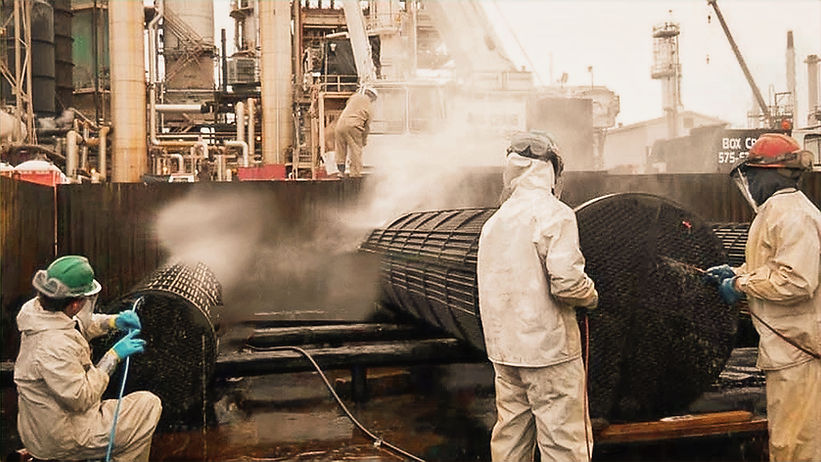
The Problem With Hydroblasting
Hydroblasting and other mechanical cleaning methods have been the global standard for heat exchanger cleaning for almost a century. It's time for a change.
4 Compounding Problems

Low Performance

Schedule Risk
Incomplete cleaning leaves efficiency on the table. Heat exchangers never return to design capacity, forcing your plant to work harder, at higher costs.

Turnaround delays cost millions in lost production. When cleaning takes longer than planned, every hour compounds across your operation.

Environmental Impact
Safety Risk

Over a million gallons per exchanger. Massive wastewater treatment. Energy waste. Your washpad is a sustainability liability.
High-pressure equipment. Heavy bundle handling. Workers near dangerous jets. Every turnaround puts your team at risk.

"Like never before, cleaning performance is critical to reducing costs and improving profits." According to Dan Coombs, the former executive vice president of global manufacturing for LyondellBasell, and a member of our advisory board: "A refinery or chemical plant relies on three major transport phenomena: momentum transfer, mass transfer, and heat transfer. The failure of momentum or mass transfer becomes evident through immediate operational disruptions requiring plant shutdown and repair. The failure of heat transfer is an insidious process, happening slowly over time and robbing your operation of efficiency and profitability. Historically, for the most badly fouled exchangers, the prospect of perfect cleaning results was not a possibility and the focus in maintenance was to get as clean as possible within the available time window. Up until now, heat exchanger cleaning has been done mostly during shutdowns in the window of time that appears during the gap between disassembly and reassembly. Up until now, cleaning efficacy has been largely ignored as a key performance indicator in washpad cleaning, or as a factor in Risk Based Work Selection."

Old Method and a Dirty Secret.
Hydroblasting has been the washpad standard cleaning method for nearly a century because it was the best option available.
But Hydroblasting has a "Dirty Secret". Even with days of spraying the method never restores large, fouled heat exchangers to 100% of their clean performance, leaving behind hardened scale, baked-on fouling, and deposits in areas high-pressure jets cannot reach.
Every turnaround, these limitations add uncertainty - costing money, time, future efficiency, and adding safety risk and environmental impact.

Environmental Consequences
The traditional hydroblasting washpad is water and carbon intensive, running large diesel pumps around the clock for the duration of a turnaround.
-
A moderately-sized washpad, fully equipped for a three-week turnaround, can be expected to emit between 500 and 1000 tons of greenhouse gas, and generate over 5 million gallons of wastewater.
-
That's the equivalent of over 2 million miles of driving for a typical pickup truck and enough clean water for 200 people for a year.
Putting a heat exchanger back into service at less than 100% of its clean performance level adds operational costs and results in higher emissions. A CPHT cleaned to 75% will emit 10-15% more CO2 during the refining process, adding 100's of thousands of tons of annual emissions to a moderately sized refinery.


High-Risk Work, by Design
The hydroblasting washpad is a dangerous place, where injuries and damage to equipment are common events.
Combine a wet, slippery environment, with exhausting labor, long shifts, extreme high pressure water injury risk through equipment failure or accident, cumbersome PPE, extreme noise, heavy equipment lifts, abundant trip hazards and the environment becomes a dangerous place for anyone.